Blog Archive

Showing posts with label dna. Show all posts

Happy 4th of July, Jack Flag

When the patriotic vigilante Jack Flag showed up in Thunderbolts post-Civil War a few years back, I imagine many figured the red, white and blue-haired hero with the American flag Grifter mask to be a cobbled together Warren Ellis creation dreamt up for the purpose of giving the T-Bolts a disposable “good guy” to demonstrate their new status quo against. I was among those who not only recognized Mr. Flag, but both gave Mr. Ellis a serious kudos for raiding Marvel’s truth depths obscurity and smiled a bit to see the return of a character from my youth who both seemed ridiculous at the onset and yet to possess some intangible coolness about him.

The year was 1994, I was 12, and it was tough to ignore the dude with the jingoistic dye job wielding what appeared to be a boom box leaping at me from the cover of Captain America #434, particularly with his name emblazoned graffiti style to the side. The introduction of Jack Flag was part of the year-long “Fighting Chance” storyline by Mark Gruenwald and Dave Hoover that saw Steve Rogers’ super soldier serum begin failing on him and Cap embark upon a mission to settle his affairs before he had to hang up his shield.

“Fighting Chance” was an extremely 90’s storyline that certainly seemed to sit in the shadow or the Death of Superman or Knightfall, taking another iconic hero and doing the previously unthinkable by laying him low and potentially putting him out to pasture. There were some eye-rolling moments like Cap’s battle vest or his Iron Man-designed armor, but because it was Gruenwald, who loved the character like few others and always tried to have fun with whatever he did, there were quite a few bright spots and cool stories too. One promising aspect was exploring how the idea of the America hero had changed with a new Super-Patriot, the ultra-violent Americop, the female-empowering Free Spirit and, finally, Jack Flag.

Jack Harrison was introduced as a guy who was a member of Captain America’s computer hotline network—a Gruenwald creation established in the 80’s as a sort of nationwide Bat Signal or network of informants for Cap—and alongside his brother Drake decided to take a more active role, forming a citizen patrol. Hard times fell on the Harrisons when Drake got crippled attempting to break up a robbery and then the Serpent Society moved into their hometown, buying off local law enforcement and forcing folks out of their homes, including Jack’s parents. Inspired by Cap, Jack began wearing a costume and went after the Serpent Society; he ended up not only helping his hero and Free Spirit take down the Serpents, but helped save Steve Rogers’ life when his super soldier serum finally crapped out.

For a few issues after “Fighting Chance” wrapped, Jack Flag and Free Spirit hung around as Cap’s support squad and possible successors, but then vanished after Mark Waid took over for his own acclaimed run, shuffled off to limbo with hundreds of other characters from the 90’s.

As I mentioned up top, Jack Flag returned over a decade later in the pages of Thunderbolts, where Norman Osborn had just taken over the team and populated it with super villains who were responsible for enforcing the new Super Human Registration act. Jack surfaced as a street level hero who continued to do what he felt was his duty despite it now being against the law because of his innate goodness as well as a lingering obligation to and admiration for Captain America, who had opposed the Act and then apparently been assassinated. He saves an innocent girl from a gang attack and then is swarmed en masse by the T-Bolts.

Two things from this story are a testament to strengths in the Jack Flag character I didn’t even really know existed despite getting a tingle of excitement at seeing a trivia question I knew the answer to resurface on the national stage: First was that he represented the type of unfettered hero with a Cap-like strength of character Ellis needed to hold up against his new Thunderbolts and demonstrate how nasty and immoral they were. The respect Ellis showed by having Jack tear through his more powerful pursuers, including Moonstone and Venom, before being felled and paralyzed by nothing less than a Bullseye sneak attack makes a statement of legitimacy for somebody who could not have been reasonably considered anything but D-list to this point.

Second, cover artist Marko Djurdjevic and interior artist Mike Deodato do not change Dave Hoover’s original costume design even a little bit, they just do it up in their respective ways and show that it was a bold, memorable collection of stylistic choices; I kinda want to start a Jack Flag sketchbook.

Most would assume that would be it for Jack Flag—and for a character who only had a few appearances to his credit prior, taking on some of the Marvel Universe’s bigger bads and getting nailed by Bullseye while doing the right thing wouldn’t be a shabby send-off—but he would return in of all places Guardians of the Galaxy, courtesy of my pals Dan Abnett and Andy Lanning. When Blaastar attempts to take over the Negative Zone prison where Jack is being held, despite being wheelchair-bound, he leads the other inmates to resist the alien tyrant, impressing Star-Lord in the process; Peter Quill gets Jack the heck out of jail and has the science whiz types on Knowhere fix up his spine so he could join the Guardians.

It always blew my mind a bit reading Guardians of the Galaxy and realizing that among cosmic powerhouses like Drax and Adam Warlock there was this footnote of a character from when I read Captain America as a kid standing shoulder to shoulder, but so much of the joy in reading DnA’s work is they love comics minutiae as much as any fan and jump at the chance to elevate characters with potential. They made Jack a fairly integral member of the team, even having folks who would know like Kang tout his grand potential in the universal scheme of things.

That a guy who called Captain America’s hotline in the 90’s and took the time to evenly separate three bizarre colors into his hair would eventually become an intergalactic champion for good is pretty much as good a representation that anything can happen in comics as you’re going to get; it’s also proof in point that the best creators in our industry not only make their own mark, but are never bashful about going back into the seemingly infinite backlog of those who came before to mine everything they can from the most forgotten of creations.

The Enigma of Adam Warlock

I’ve finally been experiencing the pleasure of reading the full Stan Lee/Jack Kirby run on Fantastic Four via the most recent re-issues of the softcover Marvel Masterworks series and though the last few volumes have brought such seminal stuff as the debuts of Galactus and The Black Panther not to mention the classic “This Man…This Monster!” Coming up next, I’ve got the first appearances of Blastaar and Ronan to look forward to, but most significantly for me, the introduction of Adam Warlock. For as long as I can remember, I’ve had questions about Adam Warlock that I’ve never been able to find answers to—admittedly I haven’t looked too hard or I would have read the Jim Starlin stories by now—and hope that perhaps by starting from the beginning, I’ll understand this character and his evolution a bit better.

Characters undergoing wild transformations in comics aren’t unheard of; in fact it’s more or less business as usual at this point. The landscape of modern comics—the super hero genre especially—is littered with figures who bear little resemblance to their original incarnations. Still, Adam Warlock’s four decade-long journey from artificial man to mystical space hero with a significant detour to cosmic messiah and fairly unveiled Christ allegory along the way is pretty unique.

The character that would become Adam Warlock debuted in 1967’s Fantastic Four #66 as Him, an artificial man created by the Enclave to be the peak of humanity. He was more a handsome gold-skinned Frankenstein than anything resembling what he would become, but relevant to this examination, he was a character firmly rooted in science—the Enclave were criminal scientists—and thus right at home in the sci-fi adventures of the FF. Him would resurface a few more times—and Her would be introduced—but he never caught on the way many other Lee/Kirby creations did.

In 1972, Roy Thomas and Gil Kane got a hold of Him and reinvented him as Adam Warlock, introducing what would become his familiar visual cues of a yellow thunderbolt emblem with red and gold gladiator flourishes as a costume. According to an old issue of Back Issue—via Wikipedia—Thomas fully intended to do a super hero version of Jesus Christ, having recently become a fan of Jesus Chris Superstar; Him had some pedigree but little baggage or history, so he made as much sense as existing character. Thomas had the High Evolutionary stand in for a higher power and evolve Adam to godhood, then dropped him on the newly-created Counter-Earth where he served as savior to its people, protecting them from the Man-Beast—a rogue High Evolutionary creation serving as the Lucifer figure—and eventually their creator—the Evolutionary again—who toyed with wiping them out.

Warlock began waxing philosophical not unlike his cosmic contemporary The Silver Surfer, but not about his plight in being trapped on Earth, rather the pressures placed on him by his power and the expectations of those he protected.

The Thomas-written Warlock saga only ran eight issues, but Jim Starlin would pick up the character not long after, writing and drawing a new story that took his messianic routine to the stars. Starlin pumped up the cosmic soap opera by introducing The Magus, Warlock’s evil alternate from a possible future, and weaving in dimension jumping and time travel as well as the established Thanos, but also continued to explore the character as more than just another super-powered bruiser, asking questions about destiny, the corruptive nature of power and what role even a supposed savior had in shaping who he would become. With Magus, Starlin also was not afraid to posit that this might not be the typical “evil twin” scenario comics fans knew well and that instead Adam may indeed by mentally ill and possessing multiple personalities. The Starlin Warlock is—from what I’ve heard—trippy, expansive, of the era and possibly the most well-regarded material that has been produced featuring the character.

This era of Adam Warlock concluded in 1977 with a three-part crossover through Marvel Team-Up, Avengers and Marvel Two-In-One that saw the character give his life to thwart a scheme by Thanos.

Adam Warlock would return 14 years later as part of the crossover event The Infinity Gauntlet, and it was around this time I would be first introduced to the character. In a story written by Starlin, Thanos, recently resurrected himself, gets a hold of the combined Infinity Gems, which grants him near omnipotence, and Warlock along with his allies Pip and Gamora are brought back from a limbo-type existence within the Soul Gem to thwart him. The good guys win and Adam actually gets the Infinity Gems himself for a moment, but they are ultimately split up amongst his chosen Infinity Watch, and they go off into their own ongoing series.

Each of the next two summers—1992 and 1993—would feature another “Infinity” event penned by Starlin, in which Warlock and Thanos would be major players and nearly every Marvel title and character would become involved. In Infinity War, the forgotten Magus gains his own existence out of Warlock’s passing wish to excise himself of all good and evil during his brief time holding the Gauntlet, and creates an army of evil twins of Marvel heroes—fun fact: this is where the Spider-Man character Doppelganger, featured in Maximum Carnage and more recently the Carnage mini by Zeb Wells and Clayton Crain, originated—so that he can try and assemble the Gems. The next year, in Infinity Crusade, Warlock’s “good” side, the Goddess, takes advantage of various heroes’ faith to brainwash them and create a super hero civil war over a decade early while trying to “cleanse” the universe by destroying it.

I vividly recall reading Infinity Crusade with my best buddy Matt Corley when I was 11 years old; when I spotted a few issues of Infinity War not long after, I snatched those up as well. It would be a while yet before I found Infinity Gauntlet in trade and got the full saga (and of course years later I’d pick up Infinity Abyss and Marvel Universe: The End, but those may be stories for another time). I was a kid, so the slam dunk concepts of bad guy duplicates and hero vs hero grabbed me pretty easily—they still would/do—but I always found myself a bit mystified at what exactly was the deal with Adam Warlock. I mean, these were huge Marvel stories that touched every single comic and featured more or less every single character available, but guys like Spider-Man, Wolverine, Iron Man and Captain America were more or less supporting characters—if that—while this orange-skinned dude with a shiny green thing on his forehead was front and center. Surely he was the most important character in the Marvel Universe, right? So why had I never heard of him?

As I mentioned in my post about Thor: Blood and Thunder, there were in fact two Warlock series—Warlock & the Infinity Watch and The Warlock Chronicles—running concurrently in the mid-90’s. At the time, I was curious about this because, again, I really had no sense of who Adam Warlock was, but at the same time, he was starring in more books than Daredevil or The Hulk. Looking back now, it’s interesting and a bit bizarre to think that Warlock, who was such a quirky, boundary-pushing figure in the 70’s would morph into the central figure of some of the most prominent projects on Marvel’s radar 20 years later—and they were written by the same guy! Adam Warlock had gone from being on the fringe of the Marvel Universe, relegated to Counter-Earth or deep space so Thomas and Starlin could dig into the idea of Jesus as a super hero without attracting too much attention, to being right in the thick of things, living on Monster Island, showing up in prominent books and ordering the A-list heroes around in the center of crossovers. If you give the Infinity trilogy and early issues of Infinity Watch a solid read, Starlin is certainly still delving into larger issues of duality, religion and the heart of what makes good and what makes evil, but he’s also writing very commercial comic books, something I can’t imagine he ever thought he’d be doing with Adam Warlock when he plucked him out of limbo decades earlier.

Adam Warlock’s 90’s glory days crashed around the same time the rest of the comic industry’s did. His books were cancelled, he was shipped over to the Ultraverse for a quick crossover/reimagining, then slipped into limbo by the end of the decade. He’d be gone a good six years or so before popping back up in the aforementioned Infinity Abyss and Marvel Universe: The End minis, both written as well as drawn by Starlin, where his primary role is to play counterpoint to Thanos, who has once again gained ultimate power and is waffling on whether or not to embrace his nihilistic tendencies or not.

The most recent Warlock resurrection came about in 2007 with Annihilation: Conquest, and I was actually at Marvel for this one. This time, Dan Abnett and Andy Lanning brought the character back—Bill Rosemann told me at the time that he was “one of the last missing pieces of the cosmic puzzle”—bringing things somewhat full circle—if you discount the Him years—with the High Evolutionary being involved and Warlock again being touted as a universal savior whose form is sought by Ultron as a host body. DnA made Adam part of their Guardians of the Galaxy series where he served as one of the team’s many wildcards, in part due to the schizophrenic nature that had long been a part of the character’s makeup and also because he had new mystic-based powers that moved him closer to fitting the Warlock name. This incarnation lasted a couple years before Adam fulfilled his seeming long ago destiny, finally becoming The Magus and getting taken down by his old teammates and later by an evil alternate version of Captain Marvel.

Going back to the beginning, I’m very much looking forward to the next volume of Marvel Masterworks: Fantastic Four—coming this November—to see the genesis of a character who would be Frankenstein, Jesus, a cosmic explorer, the center of the 90’s Marvel Universe, Thanos’ confidante and an outer space magic man; even for comic that’s a pretty wild resume and I’d like to read it all the way through.

The Best of 2010 Comics Gift-Getting Guide

While plenty of places will provide you with lists of what gifts to get for comics-loving friends and family prior to the holidays, it’s my tradition here on the Cool Kids Table to wait until after y’all have gotten all those nice gift certificates and store credits and then let you know what to spend them on.

There were a bunch of great comics this year, and while I’ve singled out 22 collections here I think deserving of your dime, I also encourage you to check out my Comics Worth Reading archives for some I may have overlooked.

AVENGERS ACADEMY: PERMANENT RECORD
Using a very specific story structure over the first almost year of Avengers Academy—the first person narration shifting from one cast member to the next each issue—I think Christos Gage has pulled off the ever-challenging task of introducing half a dozen really intriguing new characters who I’m already invested in. The series has yet to have one true overarching multi-issue story, which I kind of dig, as it gives the book a different feel and sets it apart with the emphasis really being on character and relationships over big action (though the fights are still well-done, don’t worry). This first volume provides a wonderful introduction to a unique and entertaining series with superb art by Mike McKone and others plus some fun guest stars to boot.

BATMAN AND ROBIN: BATMAN MUST DIE!
As I so often do with Grant Morrison’s work, I couldn’t fully appreciate it until all the pieces were on the table. Am I too impatient or just not smart enough to get it earlier in the game? Quite possibly both, but I still credit Morrison with being able to ratchet up the satisfaction level when it comes to that crucial “A-ha!” moment. Speaking of satisfaction, there’s a great deal involved when a story really feels like it has been building up for some time as this one has—it’s what makes good long-form television a success—not to mention when a truly great bad guy finally gets what’s coming to him, and we have both here. I also like that everybody from Dick Grayson to Damien to Commissioner Gordon to the freaking Joker—Frazer Irving’s Joker is so creepy!—and of course Bruce Wayne gets a nice spotlight without it feeling overloaded. Honestly, I feel like if you haven’t been reading Batman the past couple years, you’ll get a nice filling adventure here and if you want to sample the rest, it’s there for you, plus the set-up to the next intriguing age.

BATMAN BEYOND: HUSH BEYOND
Of all the comics I was expecting to dig in 2010, I can certainly say Batman Beyond was not high on that list, but here we are. I never watched the cartoon regularly, but the Return of the Joker movie and the characters being featured on Justice League Unlimited a couple times was enough to endear them to me. Adam Beechen did a nice job with this series of immersing you immediately in the odd but familiar world of future Gotham and mining the Bruce Wayne-Terry McGinnis dynamic for its inherent strengths. I found myself caught up in the Hush mystery—though a bit let down by the “big reveal”—and enjoying the new additions to the Beyond canon like aged Dick Grayson and Catwoman Beyond; good primer for what I hope will be a nice ongoing.

THE BOYS: THE INNOCENTS
Tough choice between this one and The Self-Preservation Society in terms of my Boys pick for 2010, as the latter had some rad standalone origin stories, but the actual action arc didn’t do so much for me, whereas both arcs contained in The Innocents are just wrenching. The story the book is named for sees Hughie going undercover in a Legion of Substitute Heroes pastiche and the way Garth Ennis handles bonafide good guys who want to be super heroes in the horribly corrupt world of The Boys is both a little heartwarming and massively heartbreaking, plus Butcher gets a kick ass moment in the midst of being a prick. The second story, Believe, is a heartbreaker, as Hughie finally learns the truth about Annie and amidst the jokes and violence is the moment we’ve been anticipating/dreading played with almost depressingly real emotion and heart. Definitely missing Darick Robertson’s art, but Russ Braun has stepped up admirably. If you think The Boys is just about shock storytelling, I’ll say as I do every year that you’re missing out.

DAYTRIPPER
I’ve said so much about how incredible I think Daytripper is this past year and I stand by all of it, so I’ll save me and you some time by linking to those thoughts and just reiterating that this is one of the most gorgeous, moving and poignant stories I’ve read in some time that I’d recommend to anybody, comics fan or no.

DOOMWAR
Jonathan Maberry and Scot Eaton’s Black Panther(s and friends) versus Doctor Doom mini-epic hit a sweet spot in my fan nerve that craves unfettered, old-fashioned “good guys fighting bad guys” stories with a dash of social relevance, but more importantly a heaping helping of outlandish action and the kinds of crazy chess moves you don’t see anywhere else but comics. Maberry wrote one of my favorite takes on Doom in years, doing justice to one of Marvel’s most complex and powerful villains while not cheaping out on the megalomaniacal speeches and insane plans. On the flipside, the T’Challa of this story is great in his role as the good guy who’s not so much a hero but rather a politician and master strategist, willing to engage Doom in a way few others have and go way outside the box. Eaton’s art is a perfect fit for the type of fun you get when you pit the X-Men, Fantastic Four, Deadpool, War Machine, etc. against an army of Vibranium-enhanced Doombots.

EX MACHINA: TERM LIMITS
It may have taken a little while to get there, but the conclusion of Brian K. Vaughan and Tony Harris’ multi-years mash-up of politics and super-heroics was worth the wait—not too surprising since BKV is one of the strongest finishers in comics. The final multi-part story was smart, harsh and unrelenting, with a great mix of intelligent social commentary and science fiction action with an added element of unworldly unease; in short, it was a good snapshot of everything that made Ex Machina what it was. The final issue, however, was really something, from the pay-offs to the shocking moments to the lengths BKV didn’t mind going to with Mitchell Hundred’s character right down to the ending I did not see coming but smiled and nodded “of course” to as soon as I turned that last page.

FABLES: ROSE RED
I love when Fables flashes back to tales of the Homelands, breaking away from the ongoing narrative and allowing Bill Willingham and Mark Buckingham to switch up storytelling styles, and this year’s “secret origin” of Rose Red was a fun, impactful story that made nice use of the concept’s central conceit—fairy tales twisted and refined with modern conventions and humor—to catapult a great character towards her next phase. That aside, this collection also contains the momentous 100-page 100th issue of the book, a true triumph for the creators with an awesome flat-out fight with Mister Dark—one of the creepiest villains in all of comics right now for my money—and the culmination of several simmering plots even as new ones begin. I’ll be interested to see how many of #100’s extras make the trade, but even just the main stuff alone is gold.

THE FLASH: THE DASTARDLY DEATH OF THE ROGUES
Geoff Johns and Francis Manapul’s first arc on the “reborn” Flash accomplished something I thought nigh-impossible: It made this diehard Wally West fanatic at least warm up to the idea of stories starring Barry Allen as the Fastest Man Alive. Don’t get me wrong, I still have my hang-ups as far as Barry being a bit bland and believe Wally has way more of an upside, but Johns the exaggerated Silver Age nobility of his lead and makes it work with a tale that takes the best characteristics of that era of storytelling—the boundless enthusiasm, that no concept is too over-the-top—and marries them to his modern bag of characterization and pacing tricks for a satisfying ride. The metaphors about speed or timeliness would usually make me groan—and they still do sometimes—but they work here as they would nowhere else. Johns also still writes the Rogues as among the best villains/supporting cast around and Manapul’s energy is palpable.

FRAGGLE ROCK VOLUME 1
Just as The Muppet Show did last year, Archaia’s anthology of stories inspired by Jim Henson’s Fraggle Rock took hold of a beloved memory from my childhood and pulled it into the present in a way I fully enjoyed as an adult. No question Fraggle Rock is perhaps the weirdest of Henson’s weird concepts—Dark Crystal aside—but the creators who worked on this book were able to grasp this quirkiness and use the mythology to build neat tableaus to entertain readers of all ages that showcased all the unique characters and settings available; great fun, hoping for more.

JUSTICE LEAGUE: GENERATION LOST VOL. 1
The DC Universe’s true outsiders finally found a place I think they’ll be comfortable for some time to come, and I think Judd Winick is doing some of his best writing in years in the process. I’ve said this before, but it’s always seemed a shame that while the Justice League International characters are likable and well-realized, they haven’t worked beyond humor and nostalgia guest shots in awhile; by putting a chip on their shoulder without hardening them too much and giving them a legitimate threat only they can stop in Maxwell Lord, Winick has done wonders and created an intriguing little mystery that’s funny and really explores the characters. Add in solid artwork from pros like Aaron Lopresti and Joe Bennett and this was my pleasant surprise of the year.

SCOTT PILGRIM’S FINEST HOUR
Certainly Bryan Lee O’Malley had a self-imposed series of hard acts to follow in crafting the finale to his Scott Pilgrim opus not to mention a high exposure movie to run up against, but I was really satisfied with Finest Hour and think the man deserves a hearty “job well done” both for this volume and the larger work he created. Perhaps better than any other chapter of the Scott Pilgrim story, Finest Hour gives equal service to the underpinning emotional coming of age story and the crazy video game action world, with the first portions of the book feeling about as real as it gets in terms of Scott coming to grips with his own past actions and then the finale being the most balls crazy final fight you could ask for. I don’t want to get too far into analyzing the nitty gritty as finer minds than mine have already done so, but I closed this book feeling satisfied and look forward to cracking it back open in the future.

SPIDER-MAN: THE GAUNTLET – LIZARD
I’m certainly not the first person to say Zeb Wells and Chris Bachalo realized a horrifying potential never before reached in perennial Spider-Man nemesis The Lizard with their story “Shed,” but I won’t disagree with it. The Lizard has always been an interesting character as far as the tried and true but evergreen trope of his alter ego Curt Conners being the unwitting vessel for a monster not to mention one of Peter Parker’s few loyal allies, but Wells didn’t fall back on that as a crutch, instead really tossing the human to the wind and embracing what a primal tale of terror you can tell with an antagonist who is nothing but animal savagery unleashed. “Shed” is frankly uncomfortable to read, but that’s what sets it apart and gives Lizard new life as a bad guy whose appearance is cause for genuine unease. Bachalo—aided by Emma Rios—is the perfect choice to lose himself in depicting a world completely off balance with the evolutionary scale tipped way out of whack.

SPIDER-MAN: GRIM HUNT
For the better part of a year, the creators and editors responsible for Amazing Spider-Man have been setting up the dominoes of juicing up Spidey’s villains while simultaneously weaving a larger story in the background involving the Kraven family. Joe Kelly had the tough task of knocking those dominoes down while also crafting a story that would overturn part of Kraven’s Last Hunt, one of the best Spider-Man stories ever—so no small task, but as he generally does, this writer rose to the occasion in my opinion. The tone of Grim Hunt shifts organically from Spider-Man going about his business in that usual cavalier manner to our hero experiencing anxiety and rage the likes of which he perhaps hadn’t since his last encounter with Kraven, and in that mood shift, Kelly really does something neat while also placing this arc right in line with Last Hunt and earning the connection. It’s a full-on saga that features a full range of heroes and villains as well as seemingly multiple incarnations of Spider-Man, a tricky return for a great character that works, a heavy emotional payload and perfectly gritty art by Michael Lark that just looks pretty.

MARVEL ADVENTURES BLACK WIDOW AND THE AVENGERS
I love Paul Tobin’s Marvel Adventures Super Heroes for the fun, funny, well-crafted stories featured month in and out in wonderfully bite-size portions, but also because it has honestly one of the coolest Avengers line-ups you’ll find anywhere: Captain America, Iron Man, Thor, The Invisible Woman, The Black Widow, The Vision, and, of course, Nova. Tobin is a master at meshing these disparate personalities for maximum entertainment as he cues up action and adventure for his artists to bring to life. This volume features the birth of the new team plus battles against such oddball foes as Diablo, Plant Man and The Silver Surfer; it’s extremely different from just about anything else out there today and if you’re looking for a consistent monthly smile, you can’t do much better, beginning here.

RETURN OF THE DAPPER MEN
No favoritism necessary for me to proclaim my buddy Jim McCann’s amazing original graphic novel from Archaia to be one of the best things I’ve read this year, because the work quite frankly backs it up. Jim imagines one of the kookiest and most intriguing new worlds I’ve had the pleasure to explore in years with his land of children and robots lacking in adults and the conventions they bring until the descent of the Dapper Men from the title. But as good as Jim’s story is—and it’s really good—I know he’d agree this would not have been the same without the sensational artwork of Janet Lee, whose eye-catching work blew my mind not to mention impressed the heck out of my mother, a full-time watercolor artist, showing how transcendent it is. I don’t feel it’s any exaggeration to say Jim and Janet have created a fairy tale for the modern age destined to be a classic.

SECRET WARRIORS: LAST RIDE OF THE HOWLING COMMANDOS
I often overlook when a new issue of Secret Warriors is coming out as it’s a real under the radar book for me, though I do tend to enjoy it; I think part of that is that Jonathan Hickman has made no bones that he’s laying out a finite tapestry here, so it’s designed more to be read as a complete work down the line rather than having standout single stories. That said, Last Ride of the Howling Commandos was a real neat little arc dropped into the middle of this year, with a bit of a break from the byzantine big picture to focus in on Nick Fury’s war-time buddies in a split story between a sentimental little guest spot from Steve Rogers and a blistering climactic campaign from the old warhorses. With character depth and considerable scope, this was Secret Warriors at its best.

THE THANOS IMPERATIVE
Dan Abnett and Andy Lanning brought their chronicles of the Marvel cosmic universe to a major head this year, paying off the Nova and Guardians of the Galaxy ongoings with a suitably epic event that returned one of the best villains around in Thanos to prominence, provided memorable geek out moments like the rise of the “Cosmic Avengers,” and featured major sacrifices to really hammer home what a big deal this all was. Nobody does this stuff quite like DnA, and it will come as no surprise to anybody who knows me and my proclivities that I enjoyed the heck out of this and saw it as a worthy bookend to Keith Giffen’s Annihilation, which it referenced more than once. Up against a neat and imaginative threat like the “Cancerverse” and its corrupt champions, the cosmic heroes shined as DnA along with Miguel Sepulveda showed why the best good guys in the galaxy don’t necessarily live on Earth.

THOR: THE MIGHTY AVENGER: THE GOD WHO FELL TO EARTH
I think me and the rest of the Internet have said about all we can say at this point about how great Thor: The Mighty Avenger is, but if by some chance you still haven’t given it a shot, well, you’re nuts. Whether you know Thor or don’t, whether you even like comics or not, this is a book that can show you why both are great and why we have a really neat way of telling stories over here, Roger Langridge’s tale of a man struggling to rediscover his home and finding a new one along the way is one that can resonate to anybody and Chris Samnee’s heartfelt and playful art only sweetens the pot. Grab this first volume and you will for sure be back for more.

ULTIMATE COMICS SPIDER-MAN: CHAMELEONS
Probably my favorite ongoing super hero comic of them all right now, Ultimate Comics Spider-Man had another strong year as Brian Michael Bendis continued to mine the brilliant idea of Aunt May having a “super hero halfway house” where Spider-Man, The Human Torch, Iceman and Gwen Stacy live while Kitty Pryde and Mary Jane show up to hang out for all its worth and then some. No book does soap opera better, and devotee of teen drama that I am, I eat this up like it’s ice cream laced with crack. There was also actual action aplenty, be it the boys trying to train the wildly out of control Rick Jones—who may or may not be Ultimate Nova—to use his powers of the Chameleon siblings taking over Peter Parker’s life, but the real meat is the quiet emotional stuff, be it the fears of a teenager who now has the power of a god or how a nasty shapeshifter can really ruin your life if they don’t care. This series seemingly doesn’t know how to lose momentum and I applaud Bendis and his talented artists for constantly reinventing it to ensure it never will.

6 Thoughts on Thanos Imperative #6

WARNING: That image right below may spoil The Thanos Imperative #6 for you (hopefully it didn’t already…sorry).

But anyhow, that my friends, is what I call a sendoff.


Some quick thoughts on what went down, since you knew I was gonna have some:

1. Did I know this was coming? Yeah, for a little while now, though not the full details. Why not? Because…

2. …even though my job in comics requires me to more or less know what’s going on and what’s ahead when it comes to Marvel, I do try to keep some suspense and avoid advance knowledge when I come, particularly in regard to my favorite character. Thus…

3. …no, I don’t know what’s next for Nova (if anything). However, the fan in me would reckon you can’t get much more ambiguous than that ending, and were I a betting man, I’d say we haven’t seen the last of the Human Rocket and that return’s gonna be a doozy.

4. If that was it, like I said, what a way to go. If you’re a fan of a character and they’re going to make the ultimate sacrifice, you can’t ask for much better than what Nova got. Willingly putting it all on the line for not just the universe, not just the galaxy, but all of reality. Not facing oblivion alone, but with one of your best buddies by your side. Literally laughing in the face of the living embodiment of death, quipping right down to your last moment. My boy got better treatment in his “demise” than a lot of characters get when they’re alive and kicking.

5. It was if nothing else an appropriate capper to the recent renaissance of Nova under the collective pen of Dan Abnett and Andy Lanning. Keith Giffen made Rich Rider one of the coolest heroes in the Marvel Universe a few years ago when he had him rip Annihilus’ guts out, and DnA bookended it with the average kid from Queens charging guns blazing Butch and Sundance style with Star-Lord at no less than Thanos himself as the world crumbled around them. In the interim, Nova got to ascend to the A-list, getting the kind of visibility he’s never before. People who never who he was or just liked his costume dig the character now—or just like his costume even more—and for a life-long fan like me, you can’t ask for much more. I’m so grateful and thrilled with what Dan and Andy have done that it feels write for them to be able to close out their chapter definitively.

6. If you’re like me and you still need your monthly Nova fix, make sure you’re picking up Paul Tobin’s Marvel Adventures Super Heroes!

I Would Like to Know More About Maelstrom

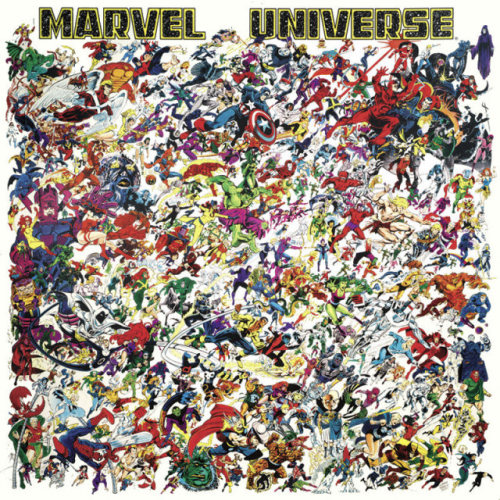
Next to my desk at work, I’ve got this poster looming over at me, depicting the entire Marvel Universe as it was back in the mid-to-late-80’s. Most of the characters I know, a couple I don’t and a few hover in between, where I am aware of who they are, but would like to know more about them. Today my gaze settled on a purple-and-blue-hued, weird-helmet-wearing fellow who I know to be named Maelstrom.

The first time I remember seeing Maelstrom outside of a Marvel Handbook was in Dan Slott and Paul Pelletier’s GLA limited series. He was a maniacal type with those ever-lovin’ ambiguous “energy manipulation” abilities and seemed wicked powerful, way above the pay grade of the generally-played-for-laughs Great Lakes Avengers. There wasn’t much insight into his origin or anything there, but I was intrigued by the fact that this was a seemingly big-deal bad guy—yeah, he was getting his ass handed to him by Mr. Immortal and Flatman, but Slott made it pretty clear that they got real real lucky and this was indeed a baddie to be taken seriously—who I had no knowledge of. I figured he was in the same league of Graviton: a villain earmarked for the A-list but who didn’t quite have the staying power to become a Magneto or Doctor Doom, so he got dusted off from time to time and I must have missed his previous campaigns.

I didn’t see Maelstrom again until just last year when Dan Abnett and Andy Lanning brought him into Guardians of the Galaxy, confronting Drax and Phyla-Vell during their quest to reclaim Moondragon from the realm of Oblivion, manipulating the latter into slaying the Dragon of the Moon and in the process becoming the new avatar of Death. Those machinations are still playing out today in the Marvel cosmic books as Phyla’s actions led to Thanos’ resurrection, seemingly another goal of Oblivion and thus Maelstrom.

This piqued my interest.

I’ve been intrigued by Oblivion since I picked up that 80’s Iceman mini where he first appeared. He’s so weird-looking and mysterious, but besides that, I have very little idea what his deal is. The big conceptual entities in the Marvel Universe are generally pretty easy to figure out: Eternity embodies everything, the Living Tribunal is a judge, Death is Death and so on. You’ve got other guys like the Elders of the Universe who are totally defined by their crazy hobbies listed in their names (Collector, Runner, Gardener, etc.).

Then you’ve got Oblivion—what’s his story? Does he want everybody dead? Everything gone? Why? What would he do if he got what he wanted? Why doesn’t Thanos want to make sweet sweet love to him?

Anyways, from what I’ve gathered, Maelstrom has some sort of tangled history with Oblivion and was his avatar—essentially his Silver Surfer—at some point. I’m not sure how that synchs up with Deathurge—Oblivion’s other flunky who gets his jollies convincing people like Hellcat to take their own lives—but it definitely ups his stock to me.

Digging deeper, Maelstrom is apparently a Deviant Inhuman, combining two major Marvel U sub-races in a formula I’ve never heard of. If that Inhumans are weird humans and Deviants are weird Eternals, does that make Maelstrom a super-weird Inhuman with some connection to the Eternals? Crazy. I must know more.

Maelstrom was also co-created by one of my favorite writers, the late Mark Gruenwald of Squadron Supreme greatness, as well as the non-Karate Kid Ralph Macchio, the long-tenured Marvel editor whom I still greet in the halls.

The Gruenwald involvement explains why Maelstrom seems to have made a lot of appearances in the Quasar ongoing series, where Oblivion was always a presence as well. I’ve really been meaning to check that one out as I used to have a real Wendell Vaughn aversion, but have conquered that, I think. For me, if Nova was Coke, then Quasar was Pepsi, so it was my duty to stay loyal to my cola, but as the two have proven able to co-exist in recent years, I’m willing to concede Wendell is Root Beer and give him a try.

On a related note, I don’t drink soda.

But regardless, Maelstrom seems like a cat with some potential and a crazy hat—more please.

Where is Force Works now?

If you haven’t read Kiel’s post from yesterday about Force Works and its prescience in terms of comic book trends, I urge you to do so now, as it’s a brilliant piece.

For my part, I figured I’d pitch in by helping flesh out the world Kiel outlined a bit and shed some light on who comprised and what became of Force Works’ semi-sprawling cast. I’m not talking about the core former West Coast Avengers guys like Scarlet Witch, USAgent and Spider-Woman, who most people know their states and whereabouts (batshit in Eastern Europe, new warden of the Raft in Thunderbolts and new Madame Web in the Spider-Verse respectively), or Iron Man, who is in limbo or something, but rather the fairly ambitious and oft-impressive original creations that Dan Abnett and Andy Lanning brought to the table over their 22 issues.

Because seriously, guys? As my good close personal friend TJ loves to say all the time, sometimes Force Works!

CENTURY
Kiel more or less covered Century yesterday and I think he’s got more to say about him yet, but I just wanted to note that every time I ask Dan and/or Andy about why he hasn’t shown up in one of their various cosmic epics, they always look at each other with little grins and give me some joke answer. I totally suspect those boys have at least one big Century story up their British sleeves…

THE SCATTER
Seriously, of the numerous alien races who populate comics, most seem pretty tame, but a few are genuinely creepy, most notably the Brood for me, but also these fuckers. Their deal was that they didn’t just conquer, but would basically descend upon planets that had already been weakened by some sort of previous threat like a swarm of locusts, set up a beachhead, and then just start consuming everything and everybody in sight until they completely hollowed the place out; they were the universe’s ultimate omnivores (besides Galactus, I guess). The grosser thing was that the alien-looking bodies we saw were actually just shells for hives of little insectoid creatures, as Spider-Woman discovered much to her horror. Lotta credit to MIA artist Tom Tenney for making these guys so icky. To the best of my knowledge, their two-issue stint in Force Works was the only time we’ve ever seen them, which seems something of a waste.

EMBER
Another neat DnA idea aided by a terrific Tenney design, Ember was the tribal champion of the Dudak, an oppressed class of people in The Scarlet Witch’s native Slorenia. Interesting twist was that there was really no one Ember, as any Dudak who touched the mystic talisman that empowered the creature became him/her/it. Outside of Force Works, Ember fought War Machine once and then got chumped out by Ultron during the “Ultron Unlimited” story in Avengers by Kurt Busiek and George Perez (I always thought it was kind of cool that Busiek took the time acknowledge a Force Works creation myself).

BLACK BRIGADE
The slightly less interesting but still visually stunning yin to Ember’s yang, Black Brigade was just your run-of-the-mill Russian cyborg who the Slorenian government hired to keep the Dudak people down. His coolest aspect was probably all the little mini-robots he had hovering around him that did his bidding (and gave him the “Brigade” part of his name). Like Ember, he showed up in War Machine and then bought it during “Ultron Unlimited.”

DREAMGUARD
I didn’t actually read the issues where Dreamguard debuted, but from what I remember from solicits and interviews, he was basically an aborigine super hero who jumped into peoples’ consciousnesses via the Australian outback (maybe). He has not shown up again, but he makes frequent appearances in various incarnations of the Marvel Handbook, so clearly he’s got a fan or two.

VOLKHVY
Another Slorenian heavy, this time with mystic powers. He made less of an impact than Ember or Black Brigade and didn’t earn any appearances outside of Force Works, though he did get a solo fight against Spider-Woman (who, believe it or not, won a letters column poll as the most popular member of the team towards the end of the Avengers West Coast run).

FISHER TODD
The Force Works tech support guy who was in love with Spider-Woman but always kinda came off as a weirdo stalker to me; after Force Works, he was never seen again.

AMANDA CHANEY
The poor PR rep for Force Works who got killed off by crazy Tony Stark during The Crossing because she figured out what he was up to. It’s kind of sad that likely more people remember Iron Man killed Luna’s nanny during that storyline than this lady. I initially suspected she was a spy or something, but if that was in the cards, DnA never got to it.

MOONRAKER
The mystery man who showed up during the early part of The Crossing as a founding member of the team and boyfriend of Spider-Woman as far as all the other characters knew, save for Spi’s daughter Rachel, who suspected something was up with him. He turned out to actually be Libra, founding Zodiac member and father of Mantis, who had altered time in order to thwart his daughter and Kang’s schemes. A few years later, Libra showed up again in Avengers Forever and flatly denied ever having been Moonraker (and made fun of the name); as that series later revealed The Crossing as being a big Immortus scheme with tons of Space Phantoms as doppelgangers of various characters, I’d suspect one of those was Moonraker.

CYBERMANCER
Suzi Endo showed up early on in Force Works during the “Hands of the Mandarin” crossover, appearing just as a scientist specializing in cybernetics at Stark Industries who got injured during an attack by the Mandarin’s Avatars and was later taken in by Iron Man as she recovered. During The Crossing, an alternate reality version of Suzi with super-powered armor named Cybermancer replaced her and worked with evil Iron Man. In the final issue of Force Works, Suzi escaped and defeated her alternate self, destroying the armor in the process. Years later, Cybermancer returned during Civil War, having created her own armor. Since then, she has helped War Machine during and after Secret Invasion plus joined the Iowa Initiative team, making Suzi Endo of all characters the sleeper breakout star of Force Works!

'Force Works' Was Ahead Of Its Time

Admission: I can't stop reading Force Works comics.


Super serial.

For anyone who doesn't know, Force Works was a Marvel team book published between 1994 and 1996 that was ostensibly a continuation of the publisher's slowly dying Avengers West Coast title with a '90s coat of paint. I'm sure even the most ardent fans don't consider the series much beyond a a footnote in Iron Man history, but the book is kind of notable for being one of the first major American efforts by reigning superhero sci-fi scribes Dan Abnett and Andy Lanning (AKA "DnA").

I don't have a tremendous amount of fanboy nostalgia for the book, though I did initially come to the series as a seventh grader. That Halloween, I went trick or treating at a buddy's neighborhood, and one of the houses there was owned by someone who must've had a comic shop because instead of Snickers or candy corn, they were passing out comics. Once the night ended, a bunch of the kids there passed their comics to me because...well, because I was that kid. So I ended up walking home with a few random things like Malibu's Deep Space Nine series and the first issues of Marvels "Marvel Action Hour" tie-ins, which were 22-page adaptations of the Iron Man and Fantastic Four cartoons in syndication – the former of which inexplicably featured Force Works prominently.

Over the rest of middle school, I watched that TV series (even though it ran at 8:00 AM on Saturday in front of a Canadian "Saved By The Bell" ripoff called "Boogie's Diner") start to finish because...well, because I was that kid too. In the meantime, I picked up a few more issues of the Iron Man Marvel Action Hour comic series – attractive to me as someone who'd never found a jumping on point to Iron Man, plus I liked the art by Anthony Williams – as well as a few scattered issues of Force Works (most memorably the series finale which I got mostly because Andrew Wildman drew it). After that, the team remained largely forgotten.

Earlier this summer, that DisneyXD cable channel started re-airing episodes of the '90s Iron Man 'toon in a little bit of inter-company cross-promotion for "Iron Man 2's" imminent arrival in theaters. When I'm up late transcribing (or writing CKT posts, even!) I end up flipping to DisneyXD's late night superhero marathons whenever MSNBC becomes too depressing, and this was no exception. Combine that confluence of events with a string of conventions this summer where the majority of my brief shopping time was spent diving in dollar bins, and I ended up nabbing a handful of the 22-issue Force Works run on a lark.

I caught up reading those books over the past week, and I'll be damned if DnA didn't turn out a story that while not an awe-inspiring game changer for the superhero genre was strangely prescient considering the trends I see in today's superhero team books. Let me show you what I mean.


1. Force Works Was A High-Concept IP Reinvention

Like I said above, when you get down to brass tacks, the Force Works monthly was a simple rebranding of the failing Avengers West Coast series. The big A franchise was hardly in the shape it is now back in '94 (I'm pretty sure the main title was in the throws of Ben's favorite "bomber jacket" era then), and so it's no surprise that the West Coast title was on its way out after a nice run of 102 issues. What is a bit different for the time was that said team would get a high-concept facelift so soon after its demise, and Force Works was the West Coast Avengers team in everything but its name. It featured most of the same characters (Iron Man, Scarlet Witch, U.S. Agent and, to start, Wonder Man) except that they got a new name, a few costume redesigns and a kitschy new tech-powered HQ.

More importantly, the big hook for the Force Works monthly was that this team wasn't just going to sit there on their laurels and wait for supervillains to attack. They were going to be proactive heroes! Or, as the tagline stated, Force Works was "The Best Defense In An Offensive World." If that hook sounds at all familiar to you, it's because the same essential idea is at the heart of a ton of current or recent hero books including Cry For Justice, JSA All-Stars, Uncanny X-Force, Outsiders and probably a half dozen other books I'm forgetting.

These days, almost every new title launched at either Marvel or DC is a tweak or twist on series or concepts from years past, generally pulled out of the back issue bin either to play on nostalgia for a former success or to polish up a good core idea with a modern allegorical twist. Force Works was both as it spent its first year showcasing how much more bad ass the West Coast cast could be in action by telling stories that allowed its heroes to get fake comic book political by taking on everything from rogue super general in former Soviet block countries to corporate raider revisions of old villains. In that respect, the book feels a lot less '90s than it probably should.


2. The Series Launched With The Death Of A Fan-Favorite Character

If you bought the first issue of that best-selling Busiek/Perez Avengers reboot and thought, "Oh hey, Wonder Man is back as an Ionic energy hero...wait! Wonder Man was dead?!?!?" (and I know some of you thought that), know that Force Works was the final resting place of former Hollywood hero hunk Simon Williams. In fact, our boy bought it straight out in the very first issue after the proactive superteam was (ironically?) caught off-guard by a rogue Kree battle ship that appeared in the skies above earth. To keep said ship from crashing into our planet and taking possibly dozens of people with it, Wonder Man flew it into the stratosphere and E-X-P-L-O-D-E-D.

Do I even need to point out how common this is these days? From ongoing series reboots like the recent killing of Ryan Choi in Titans to the death of Banshee in X-Men: Deadly Genesis and from the big events that kick off with shocking murders including Blue Beetle in Countdown To Infinite Crisis and Bullseye in Shadowland, killing an expendable but known character at the start of a story is now the go-to way to ramp up fan reactions to the book. And just as it went with Wonder Man in Force Works, the message being sent by C-list slaughter is clear: "This shit is fucking SERIOUS, you guys. You HAVE to buy our new book because EVERYTHING YOU THOUGHT YOU KNEW HAS CHANGED."

And in honesty, I'm going to give an edge to DnA and Force Works on this one too. While I know death has never been permanent in superhero comics, it still feels (to me at least) that death had a bit more gravitas attached to it back in the '90s than it did for most of the '00s. Back in the halcyon days of shoulder pads and ammo pouches, when a character like Wonder Man got killed, you had to accept that the creators who pulled the trigger weren't going to go back on that – unlike today when death and resurrection for a hero are planned from page one. In other words, back then you had to wait and see IF Marvel would bring back your fav character fro the grave. Today, you just wait to see WHEN it'll happen.


3. The Support Heroes Mattered Way More Than The Marquee Guys

All right, I know that it's been common knowledge that team books have been able to get more done with B-listers pretty much since Stan Lee introduced "Cap's Kooky Quartet" into Avengers. But even though the best team books hold the honor of kind of making the Hawkeyes and Martian Manhunters of the world feel like they might one day carry a long-running solo series, both Force Works and a number of modern team comics place extra importance on the lives of their marginal cast. And the real reason for this is that writers can fuck up the lives of said cast members.

Over their 22 issues, DnA bolstered the status of perpetual also rans like U.S. Agent and the Julia Carpenter Spider-Woman (who besides juggling an in-headquarters stalker and being a single mom ended up dating a mysterious boyfriend no one remembered appearing late in the series...though that last part was on purpose). But the most important thread in the series revolved around the alien warrior made up of 100 alien warriors' minds Century. The cosmic axe-wielding hero created by the writers specifically to work in the team got a TON of love for a complete unknown including several guest spots in Marvel Comics Presents and his own one-shot, and if I'm reading between the lines right, DnA had plans for Century to not just romance team leader the Scarlet Witch but to have a crazy space battler with her darker half on down the line.

Backstory building like this became more and more relevant as the book went along in a way that reminds me a lot of how Brian Michael Bendis essentially used New Avengers as a backdoor Luke Cage solo series here and there or how Dwayne McDuffie's entire Justice League run where seldom seen minority characters like Vixen, Bronze Tiger and Doctor Light earned more page time and development than anyone even when Superman and Batman were still on the team. In fact, the only time Iron Man – the supposed draw of the book – had a major impact on Force Works was when he was threatening to pull funding like a dad killing your garage band's practice or in one of two crossovers he anchored at the time whose plot threads were resolved in other, more important titles. Which brings me to my final comparison...


4. Ultimately, The Book's Big Plan Got Scuttled Thanks To An Event

Probably the biggest reason why Force Works left so little an impact on the Marvel Universe even for die-hard fans is because the series end dovetailed into an event called "The Crossing." If you've never heard of this story, the basic premise is that Tony Stark is driven insane by Kang (or Immortus? I honestly can't tell the fucking difference) and forced to kill a nanny who lives at Avengers mansion or some shit. In an effort to save the day, the other Avengers pull an alternate reality teen Tony from out of the past to kill the original Iron Man, and that was that. The story was so poorly received it helped convince Marvel to hire two of their biggest competitors to take over the entire Avengers franchise from scratch. So yeah...not good.

"The Crossing" pulled Iron Man out of his own team book for the better part of its second year, meaning that the "proactive heroes" high concept was largely scuttled AND that there was no big name character to help keep fan interest in the title much longer. DnA wrapped the run in the middle of a number of subplots with a story that both tied up threads from "The Crossing" probably no one wanted to have wrapped up and pulled a pretty solid "resurrection of Wonder Man" fakeout (I have no proof, but I'd like to think they did that last one just to stick it to the crybabies).

Once again, it may just be me, but this is a pattern I see repeated a lot in this era of Mobius Strip event comics which leap frog one off the back of the other again and again. From the reality TV reboot of New Warriors made cannon fodder for Civil War to half a dozen (surprisingly successful) attempts to tie Agents of Atlas to Marvel U shakeups via new #1 issues to that other New Warriors book that went from some kind of street-level teen rebellion thing to a mashup of leftover Generation X characters to a part of the Initiative and ultimately to a quiet death, the modern event era is littered with high-concept relaunches of old properties whose shelf life is somewhere between 12 months and whenever the next red sky shows up.

Ultimately, I don't think all these trends hold a lot of baring on whether or not any individual comic series is any good or not. The best creators can find ways to make cool core concepts sing no matter what the circumstances surrounding them. But I do wonder some days how many people are starting to see the reboots, redesigns and retcons of books like Force Works more as clichés rather than as creative realignment. Hell, I'm wondering if I myself can really tell the difference anymore.